Atlantic
Salt-air corrosion: spec galvanized-after-weave or vinyl coat. Frost line 1.2m.
Fences · rural
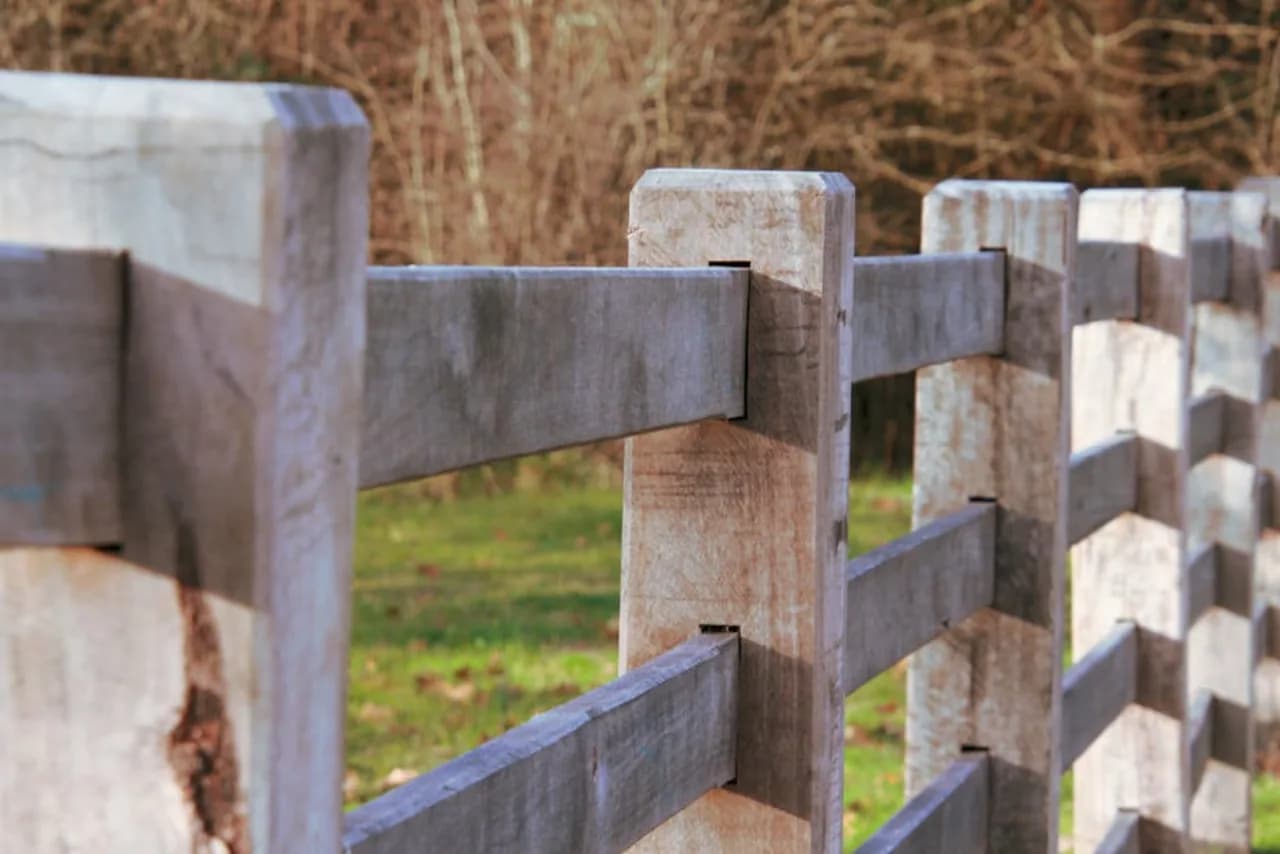
Cedar and locust split-rail. 2-rail and 3-rail. Rural property lines, farm aesthetics, large-acreage perimeters. Optional wire-mesh backing for livestock.
Split-rail is the rural property line — the fence that says "this is the back-of-the-property" without being a hard barrier. Cedar (eastern red and western red varieties) and black locust are the two species we stock; both naturally rot-resistant and aesthetically appropriate. Rails are split (not sawn) for the rough-hewn appearance, with mortised post holes accepting tapered rail ends.
Configurations: 2-rail (rails at 16″ and 32″ above grade) for purely decorative use — front lanes, orchards, vineyards; 3-rail (rails at 16″, 32″, 48″) for taller appearance and partial enclosure. Add welded-wire mesh backing (4″ × 4″ openings) to retain decorative front while creating a livestock-grade fence on the back face.
Installation: split-rail is one of the few Canadian fence types installed without concrete. Posts are 6″–7″ diameter cedar set 3′ into the earth with a gravel drainage base. The split-rail design tolerates earth heave because the rail-to-post connection is mortise-and-tenon with some flexibility. Service life: 15–25 years for cedar, 25–35 for black locust.
Rail counts: 2-rail (most common, 1.2 m height) for pasture borders and rural property lines. 3-rail (1.4 m) for horses and contained livestock. 4-rail (1.7 m) for tall horses and decorative estate use. Rails are typically 8 or 10 feet long with mortised posts at ends.
Wood species: Eastern white cedar is the historic Canadian choice — splits cleanly along the grain and lasts 30–40 years. Locust rails (where available) last 50+ years. PT pine for budget rural fencing.
Installation: Posts set in gravel-tamped footings (no concrete) for rural drainage. Rails slot into mortised post sockets — no fasteners needed for traditional installs. Modern installs may use stainless steel screws at corner posts for wind-load resistance.
Pricing & lead time: Split-rail pricing: 2-rail cedar runs $15–25 LF installed, 3-rail cedar at $22–35 LF, 4-rail at $30–45 LF, locust upgrade adds $8–15 LF. Wire backing for livestock containment adds $5–10 LF. In-stock at most dispatch hub; next-day delivery in Ontario, Quebec, and Alberta metros.
How split-rail fence stacks up against the alternatives — at a residential height of six feet, in median Canadian markets.
Stake the line, check setback rules with the municipality, locate utilities (Info-Excavation in QC, Ontario One Call elsewhere).
End, corner, and gate posts. Concrete footings to frost depth — 1.2m in most of the country, 1.8m in northern Alberta and the territories.
Spaced 10' on centre. Plumb each one before the concrete sets.
1⅝” galvanized pipe, slipped through line-post loop caps.
Tension along the top rail with a come-along, hog-ring to the rail every 24”. Tie wire every line post.
Bottom tension wire, gate hinges, latch hardware. Cap exposed wire ends.
Salt-air corrosion: spec galvanized-after-weave or vinyl coat. Frost line 1.2m.
Permis obligatoire in most municipalities. Bilingual quote PDFs standard.
OBC §9.10 for pool perimeters. Conservation Authority rules along the moraine.
Frost line 1.4–1.5m. Wind-rated panels for the shelterbelt swap-outs.
Coastal: vinyl coat. North: 1.8m frost, schedule-40 pipe for snow load.
Standard split-rail fence rails in Canada are 10 or 11 feet long for two-rail and three-rail residential and rural fence, with 8-foot rails common in older Eastern Canadian heritage patterns. The 10-11 foot length puts posts at roughly 10-foot centres, which suits standard auger and post-hole spacing. Heavier ranch and farm split-rail can run 12-16 foot rails on cedar or locust posts at wider spacing where rail strength permits. Rail dimensions: split-cedar rails are typically 4-5 inches wide and 2.5-3 inches thick at the centre, tapering at the ends to fit into post mortises. Hand-split rails (less common) are irregular by design. Pressure-treated and plastic-composite rails are dimensionally uniform. When ordering, count posts at (length / rail-length) + 1 for terminals; e.g., 100 ft of 10-ft rails = 11 posts.
Split-rail fence posts should be set 30-40% of the post height below grade, with the minimum overriding rule being depth below the local frost line. For a typical 4-foot above-grade split-rail fence, that's a 2-3 foot post-hole depth in southern Canada (where the frost line is 1.2 m / 4 ft); in Prairie or northern installs where frost reaches 1.5-2.0 m, the practical post is buried 3-5 feet — meaning the rail-height portion is shorter or you buy longer posts. Bell-out concrete footings (flared base) resist frost heave; straight cylinders don't. For most residential split-rail, gravel-tamped posts with no concrete also work because the rails are lightweight and the fence isn't structural — but in clay soils or high-frost-heave sites concrete with a wider belled base prevents leaning. Always call utility-locate before digging.
Split-rail is one of the most economical rural and decorative fence options in Canada. Supply cost for cedar two-rail split-rail runs $8-15 per linear foot supply, three-rail $12-20 per linear foot — well below wood board fence ($25-45/ft), vinyl ($25-50/ft), or aluminum picket ($35-70/ft). What makes it cheap: simple post-and-rail joinery (no fasteners, just mortise-and-tenon), lightweight rails (cheap to ship), wider post spacing than picket fence (~10 ft vs 6 ft, so fewer posts per length), and no fasteners or hardware. Trade-off: split-rail is not a containment fence (large dogs walk through, small dogs walk under), not a security fence, and not a privacy fence. It's a visual boundary marker and a rural / heritage aesthetic. Pressure-treated and plastic-composite split-rail kits cost slightly more but last longer than cedar in wet zones.
Traditional log-splitting for fence rails uses iron wedges and a sledgehammer ("go-devil") on straight-grained green cedar, locust, oak, or chestnut logs typically 8-11 feet long and 8-14 inches in diameter. Process: 1) Score the end-grain along the desired split line with an axe. 2) Drive a steel wedge into the score until the split begins. 3) Drive successive wedges along the split line to extend the crack down the length of the log. 4) Once split into halves, repeat to split into quarters; cedar splits cleanly into 4 rails per log, locust and oak into 4-8 depending on diameter. 5) Trim ends to a tapered tenon that fits the post mortise. Green wood splits cleaner than seasoned wood. Most commercial "split-rail" today is sawn-and-shaped to mimic the look — actual hand-splitting is largely heritage / hobby work. We supply both mill-cut and traditional split styles.
Split-rail fence goes by several regional names in North America: "zig-zag fence" or "snake fence" or "Virginia fence" (when laid without posts in a zig-zag pattern, an early colonial style), "worm fence" (same zig-zag style, name used in the US Midwest), "buck fence" (when X-frame posts are used instead of vertical posts, common in mountain regions), "post-and-rail" (the generic term that includes split-rail and milled-rail variants), "ranch rail" (the milled-rail style used on horse and cattle ranches), and in heritage Canadian contexts "cedar-rail fence" because eastern white cedar was the most common rail wood from Ontario eastward. The French Canadian heritage term is clôture de perche or clôture en perches (perch fence). All describe the same general construction: horizontal rails between vertical or X-shaped posts.
The name describes how the rails are made: full logs were historically split lengthwise into halves or quarters using iron wedges and a sledgehammer, producing roughly triangular or trapezoidal rails with bark on one face. Splitting was faster than sawing on a homestead — a settler with a wedge and hammer could produce rails from a felled cedar without a sawmill — and a split rail follows the wood's natural grain so it's stronger than a sawn rail of the same dimension. The English term "split-rail" is a literal description of the rail-making process; in French Canadian heritage the construction is called clôture en perches (perch fence) describing the rails rather than the splitting. Modern commercial "split-rail" is usually mill-cut and bandsaw-shaped to mimic the historical look — actual hand-split rails are now heritage / specialty.
Ready to spec it?