BLK-MT
Matte black
Default architectural finish. Powder-coated for UV stability.
Fences · ornamental
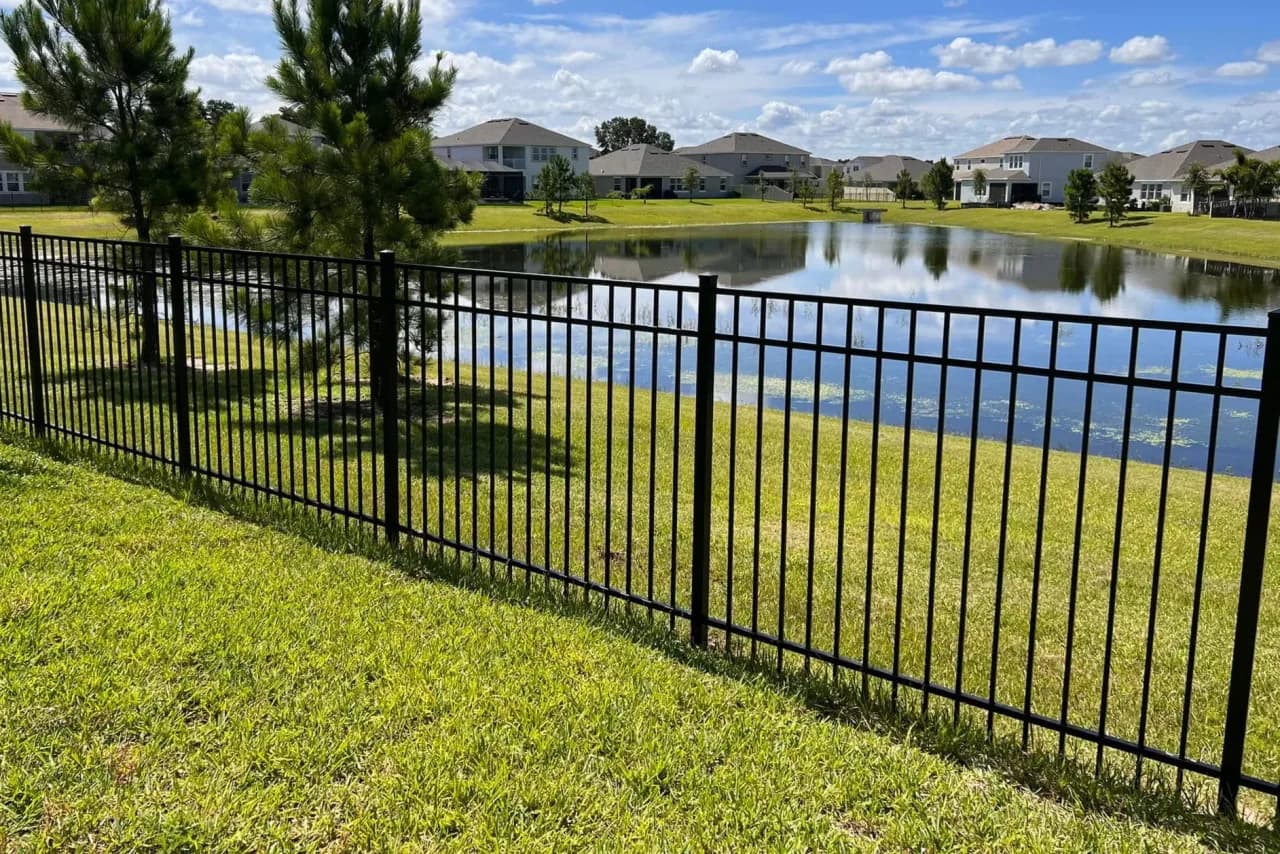
Powder-coated aluminum in 3', 4', 5', 6'. Black, bronze, white. Ornamental, pool-code (self-closing gates), commercial. Rust-proof, low-maintenance.
Aluminum is the rust-proof ornamental. The Canadian climate — salt spray on the coasts, de-icing chemicals inland — punishes painted steel and wrought-iron in coastal and urban applications. Aluminum doesn't oxidize in any meaningful way, the powder-coat finish chemically bonds to the metal, and the material is light enough that a 6′ × 8′ panel weighs roughly 50% of the equivalent steel section. Fenced.ca supplies aluminum in three grades: residential ornamental (lighter pickets, decorative top profiles like spear or ball-cap), pool-code (matching pool-enclosure regulations with 4″-max picket spacing and 1.5 m self-latching gate hardware), and commercial industrial (heavier extrusions, anti-climb spear-tops, suited to industrial perimeter and CPTED applications).
Installation: posts are pre-routed at the factory to accept rail tabs (Stryker or similar fastening system). Posts set in concrete to frost depth as with other materials. Gates use commercial-grade self-closing hinges (Magna-Latch or Tru-Close) and require careful hinge-to-post alignment for self-closing performance.
Pool-code compliance: Quebec's Règlement sur la sécurité des piscines résidentielles (2025 update) mandates 1.2 m enclosure height with no climbable surface within 1 m and self-closing self-latching gates. Our aluminum pool-code profile is supplied with engineering documentation referencing the regulation for inspector handoff.
Aluminum vs wrought iron: Aluminum gives the ornamental look of wrought iron at 40–50% lower weight and zero corrosion — no rust ever, even at coastal properties. Black powder-coated aluminum is the dominant finish (also bronze and white). Picket spacing standard 100 mm for code-compliant pool fence (Quebec Loi 322, OBC 9.10).
Pool fence specifics: Self-closing self-latching gates with 180° opening and 1.5 m latch height out of toddler reach. Aluminum + glass pool combos pair structural posts with 12 mm tempered glass infill panels for unobstructed water sightlines.
Style families: Spear top (traditional), flat top (modern), ball cap (decorative), and ring + spear (high-end estate). Heights from 0.9 m garden to 2.4 m security. Posts pre-routed for rail-and-picket assembly — 2-bolt connections per rail for wind-load shear resistance.
Pricing & lead time: Aluminum fence installed pricing: 4-foot ornamental at $45–75 LF, 6-foot privacy slat at $80–130 LF, pool fence code-compliant at $50–85 LF, commercial 2.4 m at $90–160 LF. Black powder-coat is standard; bronze and white add 10–15%. 3–5 week lead time for stocked sizes; custom heights or colours add 4–6 weeks. 20-year structural warranty, 15-year finish warranty.
How aluminum fence stacks up against the alternatives — at a residential height of six feet, in median Canadian markets.
Stake the line, check setback rules with the municipality, locate utilities (Info-Excavation in QC, Ontario One Call elsewhere).
End, corner, and gate posts. Concrete footings to frost depth — 1.2m in most of the country, 1.8m in northern Alberta and the territories.
Spaced 10' on centre. Plumb each one before the concrete sets.
1⅝” galvanized pipe, slipped through line-post loop caps.
Tension along the top rail with a come-along, hog-ring to the rail every 24”. Tie wire every line post.
Bottom tension wire, gate hinges, latch hardware. Cap exposed wire ends.
Salt-air corrosion: spec galvanized-after-weave or vinyl coat. Frost line 1.2m.
Permis obligatoire in most municipalities. Bilingual quote PDFs standard.
OBC §9.10 for pool perimeters. Conservation Authority rules along the moraine.
Frost line 1.4–1.5m. Wind-rated panels for the shelterbelt swap-outs.
Coastal: vinyl coat. North: 1.8m frost, schedule-40 pipe for snow load.
An aluminum fence in that scope — 350 linear feet of 4-foot residential-grade aluminum picket with two walk gates — typically runs $11,000 to $22,000 turnkey in Canada in 2026. Supply-only on the same scope is roughly $6,000 to $11,000. Cost breaks down as: panels at $35 to $70 per linear foot supply, posts at $45 to $90 each (frost-line dependent), walk gates at $400 to $900 each, hardware and freight 8-12% of materials, installation labour at $10 to $40 per linear foot. The two biggest variables are tier (residential vs. commercial AAMA 2604 finish) and post depth — a Calgary install with a 5-foot frost line will cost more in posts and concrete than a Toronto install on the same dimensions. We quote itemized: panels, posts, gates, hardware, freight, and install as separate lines so you see exactly what changes if you adjust scope.
Powder-coated aluminum fence has a service life of 30 to 50 years in Canadian climates with minimal maintenance — that's the longest of any fenced material we supply outside of solid wrought-iron-on-steel. Aluminum doesn't rust (the metal forms a self-protecting oxide layer), doesn't rot, and the AAMA 2604 powder-coat finish carries a 10-year warranty against fade and chalk and typically performs for 20-25 years before any touch-up. Aluminum deck railing — same alloy, same finish system — lasts the same range. The wear items are the hinges, latches, and gate hardware on operable gates, which we recommend lubricating annually. Coastal installations (Halifax, Vancouver Island, St. John's) and road-salt-heavy roadsides may see finish chalking sooner; spec marine-grade aluminum (6005-T5 or 6063-T6 with chromate primer) for those sites.
Aluminum fence is typically 20-50% more expensive than wood at install, but cheaper across a 25-year horizon because wood needs re-staining every 3-5 years and panel replacement at year 15-20. Supply-only: pressure-treated wood board fence is $20 to $40 per linear foot, cedar board $30 to $50, aluminum picket $35 to $70. Over 25 years a $30/ft cedar fence costs roughly $30 build + $15 in stain cycles + $20 in replacement = $65/ft total. A $50/ft aluminum fence over the same 25 years is $50 + maybe $2 in hinge service = $52/ft. The aluminum break-even varies by climate — drier prairies stretch wood life, coastal Atlantic and high-precipitation BC shorten it. Choose wood for warmth and screening, aluminum for low-maintenance and a tighter long-run budget.
Aluminum is one of the best fence choices for Canadian residential properties when you need ornamental appearance, low maintenance, and long service life — but it isn't a privacy material. Pros: doesn't rust through freeze-thaw, no rot, doesn't warp, powder-coat survives road salt and UV, 30-50 year service life, gates align without seasonal shimming, and the picket profile suits both heritage and modern homes. Cons: not a privacy screen (you see through it), softer than steel so a vehicle impact will dent panels, premium upfront cost vs. wood or chain-link, and dark powder-coat shades show abrasion. Strong use cases: pool enclosures (compliant with Quebec 2025 and Ontario PSWA 2015), front-yard ornamental, ravine-edge property lines, and any site where you want the fence to disappear into the landscape. Pair with privacy hedge if you need screening too.
The main disadvantages of aluminum fence are: no privacy (you see straight through the picket spacing — typically 4 inches), mechanical softness compared with steel or wrought-iron (a vehicle bump or lawn-tractor impact will dent rather than bounce), higher upfront cost than wood or chain-link, finish abrasion shows more on darker shades, and aluminum doesn't block sound. Limitations to know: it isn't suitable as a security fence by itself for high-risk sites — palisade steel or anti-climb mesh is the right call there — and the residential-grade alloys can deflect if pushed by snow load piled against a long unbraced run. The trade-off is that aluminum solves the durability and maintenance problems that wood and wrought-iron struggle with, so the choice depends on what you're optimizing for: aluminum for low-maintenance ornamental, steel for security, wood or vinyl for privacy.
Yes — aluminum is one of the top three deck-railing materials for Canadian decks, alongside powder-coated steel and glass-with-aluminum-post systems. It handles -40°C to +35°C without dimensional movement, doesn't ice-fuse like wood, the powder coat resists chloride from ice melt, and it meets the OBC, NBC, and BC Building Code 42-inch rail height and 100-mm baluster spacing requirements out of the box. Limits: avoid mounting aluminum railing directly to PT wood — the alkaline copper preservative in PT will corrode aluminum over time; use plastic or nylon isolators at the fastener interface. For commercial decks (multi-residential balconies, restaurant patios) spec AAMA 2604 powder-coat and 6005-T5 alloy at minimum; for snow-loaded mountain or Atlantic decks confirm post spacing with the manufacturer engineering tables.
Ready to spec it?