Atlantic
Salt-air corrosion: spec galvanized-after-weave or vinyl coat. Frost line 1.2m.
Fences · seasonal
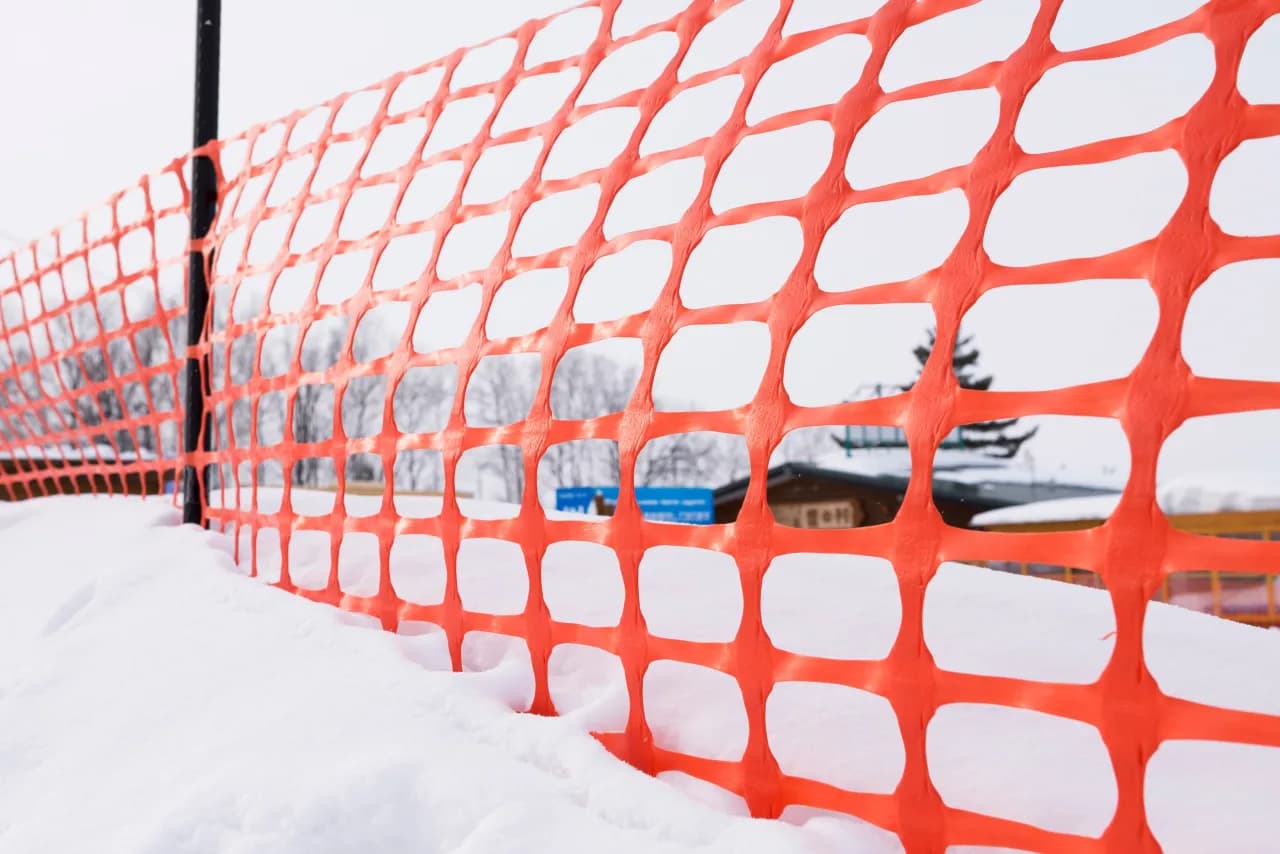
Plastic mesh and wood-slat snow fence rolls. 4' standard height. Drift control on highways, driveways, rural property. Reusable seasonal install.
Snow fence is the seasonal infrastructure. The principle is wind-physics: a 50%-porosity fence forces wind to slow and drop its snow load on the upwind side, leaving the lee side roughly 60–80% clearer than the windward. Fenced.ca supplies two substrates: plastic mesh snow fence (orange or green high-density polyethylene with 50% open weave, in 4′ × 50′ rolls; the modern standard, lightweight and reusable), and wood-slat snow fence (cedar slats wired together in 50′ rolls; the traditional appearance, heavier but more durable per cycle).
Deployment: T-posts driven 18″ into the ground at 8′ centres in the fall, fence rolls attached with steel ties. Setback 40–60′ from the road or driveway being protected — closer and the drift forms on the protected side; further and the fence doesn't catch enough snow. Removal in spring (April–May) extends fence life by avoiding UV damage and accidental damage from spring agricultural equipment.
Bulk markets: highway-maintenance authorities, municipal works departments, rural-school boards (protecting bus turnarounds), and large-acreage farms (driveway protection on prairie sections) all consume snow fence by the pallet-load. Volume contracts include pickup-and-redeployment service if requested.
Snow-fence types: Bright orange plastic mesh (lightweight, reusable, 1.2 m roll), wooden lath (traditional, 1.5 m portable sections), wire-mesh permanent (rural property edges).
Placement: Snow fences trap drifting snow upwind of roads, houses, and entry points. Standard placement: 20× fence height upwind of the protected area (e.g., 1.2 m fence → 24 m upwind). Prairie and northern BC highways use structural snow fences at 3.6 m height with 50% porosity.
Installation timing: Set up in October–November before first snow. Take down in April to allow normal land use. Posts: galvanized T-posts in soil for portable sections, concrete-set steel for permanent installs.
Pricing & lead time: Snow fence pricing: bright orange plastic mesh 1.2 m × 30 m roll runs $80–150, wooden lath portable section 1.5 m × 8 ft at $60–110 each, permanent wire mesh installed at $15–25 LF. Stocked October–November; bulk municipal orders ship in 1–2 weeks from dispatch network.
How snow fence stacks up against the alternatives — at a residential height of six feet, in median Canadian markets.
Stake the line, check setback rules with the municipality, locate utilities (Info-Excavation in QC, Ontario One Call elsewhere).
End, corner, and gate posts. Concrete footings to frost depth — 1.2m in most of the country, 1.8m in northern Alberta and the territories.
Spaced 10' on centre. Plumb each one before the concrete sets.
1⅝” galvanized pipe, slipped through line-post loop caps.
Tension along the top rail with a come-along, hog-ring to the rail every 24”. Tie wire every line post.
Bottom tension wire, gate hinges, latch hardware. Cap exposed wire ends.
Salt-air corrosion: spec galvanized-after-weave or vinyl coat. Frost line 1.2m.
Permis obligatoire in most municipalities. Bilingual quote PDFs standard.
OBC §9.10 for pool perimeters. Conservation Authority rules along the moraine.
Frost line 1.4–1.5m. Wind-rated panels for the shelterbelt swap-outs.
Coastal: vinyl coat. North: 1.8m frost, schedule-40 pipe for snow load.
Snow fence cost in Canada in 2026 depends on type. Plastic (HDPE) orange or black snow fence in 50-ft or 100-ft rolls: $40-150 per roll supply, equivalent to $0.80-1.50 per linear foot, expected life 1-3 seasons. Wood lath snow fence (traditional vertical wood slats on wire) in 50-ft rolls: $80-200 per roll, $1.50-4.00 per foot, life 5-10 seasons with proper rolling and storage. Permanent structural snow fence (wood, steel, or composite, installed on driven posts as a long-term winter wind-break for highways, ranches, and rail lines): $15-40 per linear foot installed, 20+ year life. Add posts and zip-ties for plastic snow fence at $3-6 per post (T-post or 2x2 wood). Snow-fence-as-construction-barrier (cheap orange plastic on stakes) is properly a different product class — see temporary fence for site barrier; snow fence proper is engineered to trap drifting snow upwind of a target.
Snow fence is worth it for residential properties only in specific situations: 1) Open prairie, lake, or field exposure where prevailing winter wind crosses long fetch and drifts onto your driveway, walkway, or septic field. 2) Properties where the driveway crosses a wind-exposed approach and you regularly plow more than 30 cm of drifted snow. 3) Rural homes where access matters for emergencies during storms. It's NOT worth it for: suburban lots with surrounding buildings (wind doesn't get the fetch needed for drifting), urban lots, sheltered properties with mature tree windbreak. Practical install: position the fence 15-25× the fence height upwind of what you're protecting (i.e., a 4-ft snow fence 60-100 ft upwind of the driveway) — the protected zone is downwind, not at the fence itself. A 100-foot run of plastic snow fence costs $80-200 supply and can save real plow time on the right site.
Yes — snow fences work by reducing wind velocity downwind, which causes the wind to drop its snow load into a controlled drift pattern instead of where you don't want it (driveways, roads, doorways). Decades of agricultural and highway research (Manitoba Highways, Wyoming Department of Transportation, Saskatchewan agricultural extension) document drift reductions of 60-90% in protected zones when fences are placed correctly. The key word is correctly: fence porosity should be 40-50% (solid panels create scour rather than drop), fence should run perpendicular to prevailing winter wind, and the protected zone is 15-25× the fence height downwind — not at the fence itself. A fence placed too close to the road doesn't help, it makes drifting worse at the road. Snow fence doesn't "stop" snow; it relocates it into a controlled drift, so you also need space for the drift to form.
Snow fence should be installed with a bottom gap of 10-15% of the fence height above grade — for a 4-foot snow fence that's 5-6 inches off the ground. The gap is critical: it accelerates wind under the fence and prevents a scour pattern that would erode the protective drift directly behind the fence. Without the gap, the drift forms tight against the fence and provides less protection downwind. With the correct gap, the drift forms a longer, lower profile and the protected zone extends 15-25× the fence height downwind. Permanent structural snow fences (Wyoming-style highway barriers) are typically 8-12 ft tall with proportional 12-18 inch ground gaps. For temporary plastic snow fence, leave a measured gap when you stake; people often install it touching grade and wonder why drifts pile right at the fence.
Standard roll lengths for snow fence in Canada in 2026: plastic (HDPE) orange or black snow fence is sold in 50-ft and 100-ft rolls, 4-ft height being the most common. Wood lath snow fence is typically 50 ft per roll at 4 ft height; some heavy-duty wood lath ships in 25-ft rolls because of weight. Geotextile and woven mesh snow fence may come in 100, 150, or 300-ft rolls depending on supplier. For a quick plan: measure the linear distance you need to cover, add 10-15% for overlap at posts and waste, and round up to the nearest roll size. Fenced.ca stocks 50-ft and 100-ft plastic snow fence rolls in 4-ft and 6-ft heights at all our Canada-wide network; commercial wood lath is special order with 7-10 day lead time.
A snow fence's purpose is wind management: it slows wind velocity locally so the wind drops the snow it's carrying in a controlled location, sparing the area downwind. Practical uses in Canada: protecting highways and rural roads from blowing snow (transportation departments use permanent structural snow fence along high-exposure corridors), keeping driveways and ranch yards clear (residential and farm use), protecting septic fields from heavy drift compaction, sheltering livestock yards, sand-trapping on beaches in summer (same physics, different particle), and as living-snow-fence alternatives — single or double rows of evergreen trees that act as a permanent porous windbreak. Snow fence is not a barrier in the security sense; it doesn't stop snow, it relocates the drift. Used as a worksite barrier (the bright orange you see on construction sites) it's properly classified as construction/temporary fence not snow fence.
Ready to spec it?