GAW · GBW
Galvanized
Zinc coating applied before or after weaving. Standard for industrial use.
Fences · perimeter
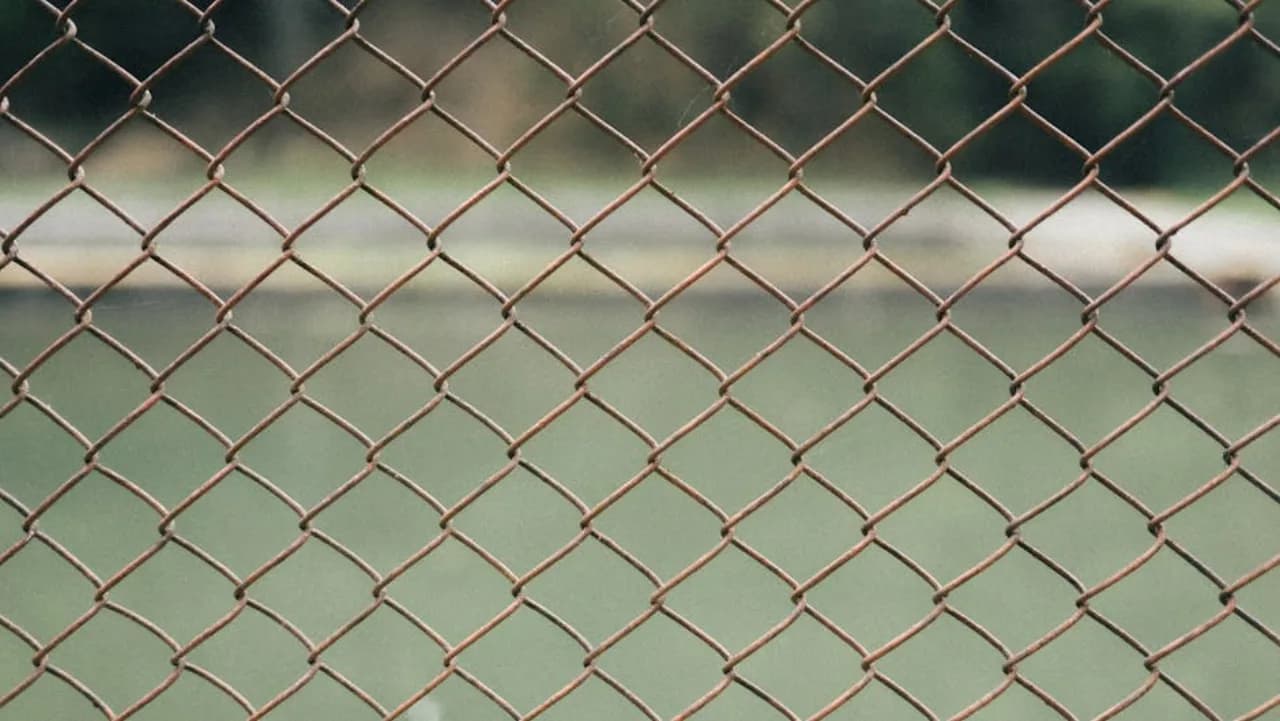
Galvanized and vinyl-coated chain-link in 3', 4', 5', 6', 8', 10', 12'. 9 to 11.5 gauge. Class 1 / Class 2C / vinyl colours black, green, brown.
Chain-link is Canada's workhorse perimeter fence. The diamond-mesh weave with top-rail and tension wire is structurally efficient — strong against lateral loads, transparent enough to retain sightlines, and the cheapest installed linear foot in our 20-category catalog. Fenced.ca stocks galvanized (Class 1 for short-life and rental applications, Class 2C for permanent commercial installs) and vinyl-coated in black, dark green, and brown. Heights start at 3′ for residential yard and dog-run, run through the 6′ commercial standard, and reach 8′ to 12′ for school grounds, industrial yards, and high-security perimeters.
Gauge selection follows use: 9 gauge (heavier wire) for commercial; 11 gauge for general residential; 11.5 gauge for cost-sensitive temporary. Mesh sizes are typically 2″ for residential and 1-3/4″ for school and ball-field where smaller mesh prevents foothold climbing. Top rail is 1-5/8″ to 2″ galvanized tube. Posts run 1-5/8″ line, 2-3/8″ end/corner/gate for residential, and 3″ schedule-40 line + 4″ end on commercial 8′ work.
Engineering: posts must be set below frost depth — see your city page. Concrete footings are 8″–12″ diameter, with the post pre-set on a 4″ gravel drainage base. Tension wire and brace bands prevent sag between line posts at 8′–10′ centres. Fenced.ca supplies the wire by the roll or full-pallet, mill-test-certified, with all accessories (rail-end caps, brace bands, tension bars, gate hardware) in single-source bundles.
Installation notes: Posts are set in concrete footings 1.2 m deep in most Ontario, Quebec, and Maritime markets — deeper in the Prairies and northern BC where frost penetrates 1.5–2.4 m. Top rails are 1¼-inch galvanized SS40 with drive-fit caps. Mesh is hog-ringed every 600 mm on the tension band, then tensioned with a come-along to manufacturer torque specs.
Regional variants: Coastal BC uses PVC-coated black mesh for salt-air protection (Class 2C galvanized base + PVC top coat = 30-year service). Alberta oilfield perimeters use 9-gauge mesh with barbed-wire toppers. Quebec municipal grounds standardize on forest-green PVC to blend with parks. Atlantic Canada specs Class 2C for the harshest salt corrosion.
Pricing & lead time: Supply-only chain-link runs $15–25 per linear foot for 1.8 m residential vinyl-coated, $25–40 LF for 2.4 m commercial Class 1 galvanized, and $40–65 LF for 3.6 m security-grade with privacy slats. Installed adds $25–35 LF depending on terrain and post depth. Quotes returned in 24 hours for residential, 48 hours for commercial CCDC-2 tenders. In-stock SKUs ship next-day from our Toronto, Montreal, Calgary, and Vancouver dispatch hub; custom heights or vinyl colours take 5–10 business days.
How chain-link fence stacks up against the alternatives — at a residential height of six feet, in median Canadian markets.
Stake the line, check setback rules with the municipality, locate utilities (Info-Excavation in QC, Ontario One Call elsewhere).
End, corner, and gate posts. Concrete footings to frost depth — 1.2m in most of the country, 1.8m in northern Alberta and the territories.
Spaced 10' on centre. Plumb each one before the concrete sets.
1⅝” galvanized pipe, slipped through line-post loop caps.
Tension along the top rail with a come-along, hog-ring to the rail every 24”. Tie wire every line post.
Bottom tension wire, gate hinges, latch hardware. Cap exposed wire ends.
Salt-air corrosion: spec galvanized-after-weave or vinyl coat. Frost line 1.2m.
Permis obligatoire in most municipalities. Bilingual quote PDFs standard.
OBC §9.10 for pool perimeters. Conservation Authority rules along the moraine.
Frost line 1.4–1.5m. Wind-rated panels for the shelterbelt swap-outs.
Coastal: vinyl coat. North: 1.8m frost, schedule-40 pipe for snow load.
Panels, rolls, pallets. Chain-Link Fence shipped to every Canadian postal code, with itemized 24-hour quotes.
Daily, weekly, multi-month tiers for temporary deployments. 48-72 hour delivery in major metros.
Regional installer network, frost-line and climate-spec engineered. Permits and inspection coordinated.
Class 1 and Class 2C refer to the zinc coating weight on galvanized chain-link mesh under ASTM A392. Class 1 carries 1.2 oz of zinc per square foot of wire surface — the residential / light-commercial standard, expected service life 15-25 years in most Canadian climates. Class 2C carries 2.0 oz/sq ft — the industrial / heavy-commercial standard, service life 35-50 years. Class 2C is recommended for coastal installs (Halifax, Vancouver, St. John's), industrial yards with chemical exposure, road-salt-heavy sites, and any project with a 25-year warranty target. The price delta supply-only is typically 15-25%; the freight, posts, gates, and labour are identical, so the lifecycle ROI on Class 2C is strong for any install you expect to last beyond 20 years. We stock both at all our Canada-wide network.
1,000 linear feet of chain-link fence in Canada in 2026 typically runs $15,000 to $35,000 supply-only and $25,000 to $60,000 turnkey, depending on height, wire gauge, and finish. A 4-foot residential Class 1 galvanized run at 11.5-gauge falls at the low end (~$15-22 per foot supply). A 6-foot commercial Class 2C run at 9-gauge with top rail, tension wire, and barbed-wire extension arms falls at the high end (~$30-35/ft supply). Add 60-100% for installed pricing depending on city, frost line, and gate count. For 1,000 feet you'll need roughly 100 line posts (10 ft spacing), 8-12 terminal posts (corners + ends + gate posts), and 3-6 gates depending on site access. Get an itemized quote — at this scope, freight and gate choice change the total more than a $1/ft mesh difference.
Privacy slats turn an existing chain-link fence into a 75-90% visual screen at roughly $4 to $10 per linear foot supply — a fraction of replacing the fence with a solid privacy panel. They're worth it when: you already have a structurally sound chain-link run, you need screening fast, and you're not in a high-wind site. They're not worth it when the chain-link is rusted at the bottom rail (slats hide that — they don't fix it), when wind exposure is severe (slats turn a permeable fence into a sail and can pull posts), or when you want a true privacy fence — slats still show some visibility through gaps and they fade in 5-8 years of UV. Best slats: aluminum or HDPE in 8-12 ft drop-in lockable styles; vinyl tube slats for the highest screening (90%+) but most wind load.
Three practical paths to convert chain-link to privacy, in increasing cost: 1) Insert privacy slats — vertical aluminum or HDPE strips that lock into the mesh diamonds, gives 75-90% screening at $4 to $10 per linear foot supply, install in a weekend on existing fence. 2) Add a privacy screen fabric or windscreen — vinyl-coated polyester or HDPE mesh in green/black/tan, zip-tied to the fence frame, 85-95% screen at $2 to $5 per linear foot but degrades in UV at 5-7 years. 3) Build a new privacy fence inside or outside the chain-link line — wood, vinyl, or composite — using the chain-link as the legal property fence and the new fence as the screen at $30 to $70 per linear foot. Choice depends on budget, wind exposure, and how permanent the privacy needs to be.
Installing privacy slats is a one-day DIY job for a typical residential run. Step 1: measure fence height and order vertical slats sized 6 inches taller than the fence (you'll trim or fold the top). Step 2: starting from a terminal post, feed slats diagonally through the chain-link diamonds — most slats are designed to slide through alternating diamonds top to bottom. Step 3: secure the lockable channel or bottom locking strip across the bottom rail; this prevents slats walking up in wind. Step 4: trim tops with tin snips and cap any sharp edges. Tools: tape measure, tin snips, cordless drill if you need to attach a locking channel. For a 100-foot fence allow 4-6 hours for one person, 2-3 for two. Don't insert slats on a windy day — partial coverage flaps and walks.
Alternatives to drop-in privacy slats for chain-link: 1) Windscreen / privacy fabric — vinyl-coated polyester mesh in 6'-12' rolls, zip-ties to the frame, 85-95% screening, $2-5/ft supply, lasts 5-7 years. 2) Bamboo or reed rolls — natural look, $3-8/ft, lasts 3-5 years, best on sheltered sides. 3) Climbing plants on a wire trellis — slow but free at year 3+, English ivy or Boston ivy in zone 5+, Virginia creeper in zone 3+. 4) A second fence inside the chain-link line — wood, vinyl, or composite — the chain-link stays as legal boundary and security, the new fence does screening. 5) Hedge — cedar or yew, plant 24 inches off the fence so roots don't crowd posts, full screen in 4-6 years. Each trades budget, install speed, longevity, and look.
Ready to spec it?