Atlantic
Salt-air corrosion: spec galvanized-after-weave or vinyl coat. Frost line 1.2m.
Fences · privacy
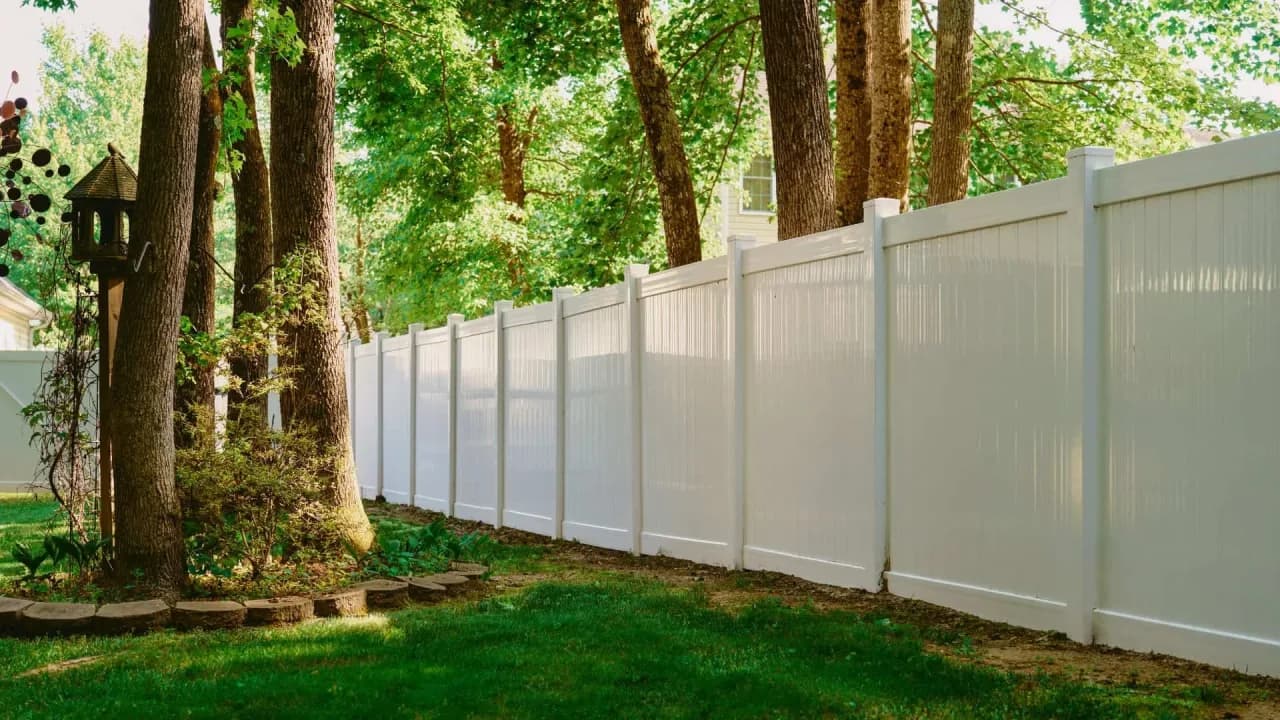
6' and 8' privacy in wood, vinyl, composite, and steel-look louvered panels. Wind-rated, snow-load-rated for Canadian climates. Pre-built panel or build-on-site.
The privacy-fence category exists because the buyer's intent is the privacy, not the material. Fenced.ca supplies privacy in four substrate categories: wood (cedar, PT pine, spruce — see /fences/wood), vinyl PVC (see /fences/vinyl), composite (recycled HDPE + wood fibre — wood look, vinyl maintenance, 30-year warranty), and steel-look louvered panel (horizontal aluminum or steel louvers in a modern aesthetic, popular in 2024–2026 contemporary residential builds).
Composite is the technically optimal choice for Canadian homeowners who don't want to choose between wood aesthetic and vinyl maintenance. The HDPE+fibre boards look like stained cedar from a distance, weigh roughly 1.6× as much as cedar (improves wind tolerance and acoustic absorption), are immune to rot and insects, and carry 25–30 year warranties without fading. The trade-off is cost — composite is 1.5–2× cedar pricing per linear foot installed.
Steel-look louvered panels are the contemporary option — horizontal slats with adjustable gap (typically 0.5″–1.5″) that breaks sightlines while allowing airflow. The aesthetic is unmistakably 2020s, and the powder-coat finish offers any architectural colour. Best for new builds and renovations targeting a modern look.
Engineering: 6′ privacy needs 4×4 posts at 8′ centres, 8′ height needs 6×6 posts at 6′ centres for wind resistance. Posts to frost depth in concrete on gravel base.
Privacy panel options: Solid wood board-on-board, vinyl tongue-and-groove, composite (recycled plastic + wood fibre), aluminum with privacy slats, and chain-link with woven slats. Each balances opacity, wind shear, and price.
Wind-load engineering: A solid 1.8 m × 2.4 m privacy panel acts as a sail — 44 kg of force in a 80 km/h gust. Posts must be engineered to resist overturning. Standard install: 4×4 PT post in 305 mm concrete footing 1.2 m deep in Ontario residential. Prairie heights >1.8 m typically use 6×6 posts on 1.8 m centres with concrete footings 1.5 m deep.
Acoustic privacy: Mass-loaded vinyl panels or layered solid-wood + acoustic underlayment cut neighbour noise by 6–10 dB. Common in Toronto and Vancouver near-highway residential. Specify STC-rated panels for measurable acoustic reduction.
Pricing & lead time: Privacy fence installed pricing varies by material: PT pine board-on-board at $35–55 LF, cedar horizontal modern at $70–110 LF, vinyl privacy at $50–80 LF, composite privacy at $80–130 LF, aluminum-slat privacy at $90–150 LF. Higher gauge posts and wind-engineered footings add $5–15 LF for properties in wind-rated zones (coastal BC, Prairies). Quote returned in 24 hours; install starts in 5–14 days depending on permit and material lead time.
How privacy fence stacks up against the alternatives — at a residential height of six feet, in median Canadian markets.
Stake the line, check setback rules with the municipality, locate utilities (Info-Excavation in QC, Ontario One Call elsewhere).
End, corner, and gate posts. Concrete footings to frost depth — 1.2m in most of the country, 1.8m in northern Alberta and the territories.
Spaced 10' on centre. Plumb each one before the concrete sets.
1⅝” galvanized pipe, slipped through line-post loop caps.
Tension along the top rail with a come-along, hog-ring to the rail every 24”. Tie wire every line post.
Bottom tension wire, gate hinges, latch hardware. Cap exposed wire ends.
Salt-air corrosion: spec galvanized-after-weave or vinyl coat. Frost line 1.2m.
Permis obligatoire in most municipalities. Bilingual quote PDFs standard.
OBC §9.10 for pool perimeters. Conservation Authority rules along the moraine.
Frost line 1.4–1.5m. Wind-rated panels for the shelterbelt swap-outs.
Coastal: vinyl coat. North: 1.8m frost, schedule-40 pipe for snow load.
Three tiers of solution to block sightlines from neighbours: 1) Solid privacy fence — 6 ft vinyl, wood board, or composite at $30-70 per linear foot supply; full screening, hard boundary, code-permitted in most residential zones up to 2.0 m without permit. 2) Lattice top with solid bottom — 4 ft solid + 2 ft lattice or trellis for vines, $25-50/ft; lets light through, reads less imposing than full solid. 3) Living screen — cedar hedge or columnar Serbian spruce planted 24 inches off the property line, full screen in 4-6 years, $200-400 per tree at install. Hybrid approach is common: solid fence on the close-pressure side (back neighbour), open picket or hedge on lower-pressure sides. Check zoning before going to 6 ft — most municipalities allow 1.8-2.0 m in side/rear yards without permit; height limits in front yards are usually 1.0-1.2 m.
True one-way visual fencing doesn't exist outdoors — physics doesn't let a passive material be transparent in one direction and opaque in the other. The closest practical solutions: 1) Angled louvre / shadow-box fence — overlapping vertical boards offset front and back, creates near-full screening from a perpendicular sightline but allows you to see through at acute angles (looking down the fence line). 2) Horizontal louvre with slight downward tilt — angles like venetian blinds, designed so a standing neighbour sees opaque while a seated person inside sees through. 3) Dense hedge with a clear line of inside footpath — the hedge depth creates an asymmetric view. 4) Solid fence with strategic gap or window opening at your seated eye level. For a real "see-out, not-in" effect inside your yard, position seating where the screening geometry favours you, or use a 6-ft solid fence and accept losing the long sightline outward.
Cheapest privacy fence options by ascending cost: 1) Privacy slats on existing chain-link — $4-10 per linear foot supply if chain-link is already up; converts an open fence to 75-90% screen in a weekend. 2) Privacy windscreen fabric — $2-5 per foot supply, zip-tied to existing chain-link or temporary frame, 85-95% screen, 5-7 year UV life. 3) Pressure-treated wood board fence at 6 ft — $25-40 per linear foot supply, install yourself in a long weekend for a 100-ft run, 12-20 year life with annual stain. 4) Cedar board fence — $30-50 per linear foot supply, ages to silver-grey naturally, longer maintenance interval than PT. 5) Vinyl tongue-and-groove privacy panel — $35-60 per linear foot supply, no painting, 25+ year life. For lowest absolute upfront, slats on existing chain-link wins; for lowest 25-year cost, vinyl wins.
If you already have a chain-link, picket, or rail fence, the cheapest way to add privacy without replacing it: 1) Privacy slats (chain-link only) — $4-10 per linear foot supply, drop-in vertical slats, 75-90% screen, lockable bottom strip. 2) Reed or bamboo roll — $3-8 per foot, zip-tied to any open fence, natural look, 3-5 year life. 3) Windscreen fabric — $2-5 per foot, vinyl-coated polyester, best on chain-link or wire panel. 4) Plywood or cedar boards on furring strips attached to picket fence — converts to solid wood at $8-15 per foot in materials. 5) Climbing plants on a wire trellis fastened to the existing fence — long lead time but free at year 3+. For an existing wood picket or board fence with gaps, scab-on cedar slats inserted between existing boards close the gaps for $8-12 per foot supply.
Cheapest new privacy fence from scratch: pressure-treated 1×6 board fence, 6 ft tall, on 4×4 PT posts set in concrete. Materials for 100 linear feet of perimeter (assume 6-ft post spacing, 17 posts, 600 board-feet of 1×6, 200 board-feet of 2×4 rails, 17 bags of fast-set concrete, screws): $1,800-3,000 supply depending on lumber market. Install in 2 weekends for two people with basic tools (post-hole digger or rented auger, drill, level, miter saw). DIY total ~$20-30 per linear foot. Going pro on the same fence runs $40-65 per linear foot turnkey. Where to save: buy lumber direct from a mill, not big-box; use brown PT for posts and cedar only for the visible boards; build it 5 ft instead of 6 ft if your zoning allows. Where not to save: post depth — set below frost or it leans inside 5 years.
Maximum height for a privacy wall on a residential patio in Canada is set by your municipal zoning bylaw — there's no single national or provincial number. Common patterns: detached residential side and rear yards typically allow 1.8 m to 2.0 m (6.0 to 6.5 ft) without permit; over that requires a fence or accessory-structure permit. Toronto allows 2.0 m in side/rear without permit; Vancouver allows 1.83 m; Montreal varies by borough but is commonly 2.0 m. Front yards are usually limited to 1.0-1.2 m. Attached to a deck or elevated patio: if the privacy wall is structurally part of the deck rail, height limits switch to building-code rail requirements (1.07 m / 42 in. for residential decks under 1.8 m above grade, 1.07 m for higher) and the privacy panel above the rail is treated as a screen accessory. Check your zoning bylaw specifically for "fence height" and "accessory structure height."
Ready to spec it?