Atlantic
Salt-air corrosion: spec galvanized-after-weave or vinyl coat. Frost line 1.2m.
Fences · structural
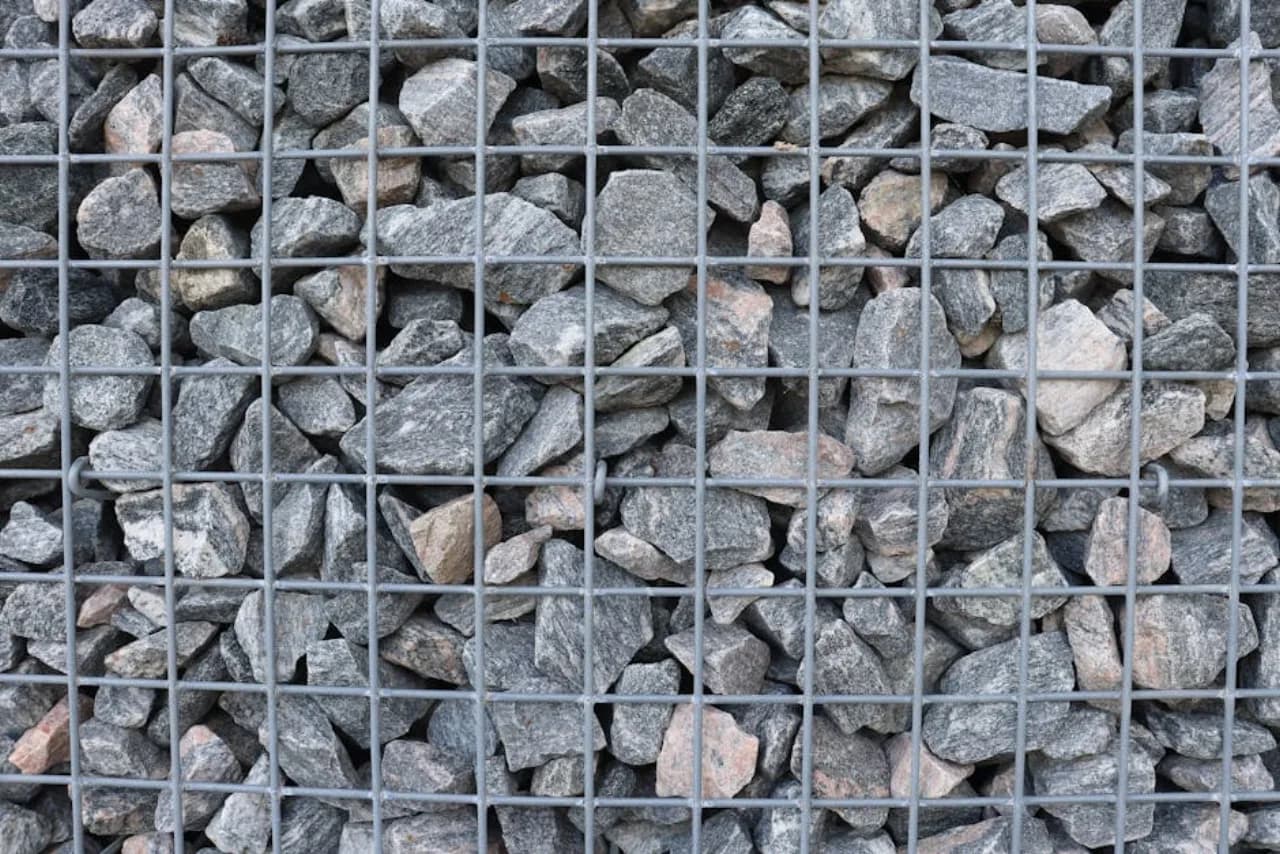
Welded-mesh and twisted-mesh gabion baskets, mattresses, sack gabions. Galvanized + PVC-coated. Retaining walls, erosion control, decorative architectural.
Gabion is the engineering category that doubles as architecture. The wire basket filled with stone is one of the oldest engineered retaining structures (Roman aqueducts used wicker-and-stone gabions) and one of the most contemporary architectural materials (gabion garden walls, gabion cladding, gabion benches all feature in 2020s landscape architecture). Fenced.ca supplies welded-mesh gabion baskets (rigid PVC-coated or galvanized wire welded at every intersection; the architectural choice for visible work), twisted-mesh (woven hexagonal) gabions (the engineering substrate for retaining walls and erosion control; flexible, ground-conforming, cheaper per ft³), gabion mattresses (thin gabions for slope-protection and channel-lining), and sack gabions (round vertical gabions for column-and-wall design).
Filling: gabion is engineered to be filled on-site with stone. On-site fill (excavated rock) is cheapest; quarry-run (limestone, granite, sandstone) is the engineering default; decorative fill (river rock, slate, recycled glass, even bottles for art-gabion) is the architectural choice. Fill stone must be larger than the mesh opening — typically 100–250 mm diameter for standard 100×100 mm mesh.
Retaining-wall engineering: gabion walls ≥ 1.2 m height require stamped engineering drawings — base preparation, drainage detail, geotextile separation behind the wall, fill specification, batter angle (typical 6° rear lean). Fenced.ca supplies engineered drawings as part of any commercial gabion-wall order.
Stone fill: Locally-sourced quarry stone, 150–250 mm graded, density ≥1500 kg/m³. Cost depends on quarry proximity — Ontario projects often use limestone from the Niagara Escarpment quarries; BC uses basalt from interior quarries. Avoid round river stone (slumps under load).
Wire grade: Galfan-coated (95% zinc + 5% aluminum) wire lasts 2-3× longer than standard galvanized in coastal and acid-rain environments. Maccaferri and Hesco are the dominant Canadian suppliers. Mesh aperture 80 mm × 100 mm for 2 m × 1 m × 1 m baskets is the standard retaining-wall format.
Engineering: Gabion retaining walls follow CSA S304 masonry-style design with geotextile drainage layer behind. Heights above 3 m require P.Eng-stamped structural drawings. Walls can be stepped for slope retention or vertical for property-line walls.
Pricing & lead time: Gabion pricing: 2 m × 1 m × 1 m basket runs $120–180 each empty, stone fill at $60–120 per ton delivered, installation labour at $80–150 per cubic metre. P.Eng-stamped drawings included for walls >3 m height. 2–4 week lead time for galvanized baskets; 6–8 weeks for Galfan-coated.
How gabion baskets & walls stacks up against the alternatives — at a residential height of six feet, in median Canadian markets.
Stake the line, check setback rules with the municipality, locate utilities (Info-Excavation in QC, Ontario One Call elsewhere).
End, corner, and gate posts. Concrete footings to frost depth — 1.2m in most of the country, 1.8m in northern Alberta and the territories.
Spaced 10' on centre. Plumb each one before the concrete sets.
1⅝” galvanized pipe, slipped through line-post loop caps.
Tension along the top rail with a come-along, hog-ring to the rail every 24”. Tie wire every line post.
Bottom tension wire, gate hinges, latch hardware. Cap exposed wire ends.
Salt-air corrosion: spec galvanized-after-weave or vinyl coat. Frost line 1.2m.
Permis obligatoire in most municipalities. Bilingual quote PDFs standard.
OBC §9.10 for pool perimeters. Conservation Authority rules along the moraine.
Frost line 1.4–1.5m. Wind-rated panels for the shelterbelt swap-outs.
Coastal: vinyl coat. North: 1.8m frost, schedule-40 pipe for snow load.
A properly built gabion wall lasts 50 to 100 years in Canadian climates, with the basket wire being the limiting factor. PVC-coated galvanized welded mesh — the standard for residential and decorative gabions — carries a 50-60 year design life. Galvanized-only welded mesh runs 30-50 years, accelerated by road salt or coastal salt spray. Heavy galfan or stainless mesh used in marine and infrastructure work pushes the life to 75-100+ years. The fill effectively lasts forever — what fails is the basket. Specify welded mesh (not woven) for retaining applications, a compacted gravel base with geotextile underlayment, and internal tension wires on walls taller than 1.5 m.
Gabion walls are usually 30-50% cheaper than poured-concrete retaining walls for the same retained height, with the gap widening on taller installs. Gabion supply runs $40-90 per square face foot installed (basket, fill, geotextile, base prep), depending on basket spec and stone choice. Poured-concrete retaining wall runs $80-180 per square face foot installed, more if engineered footings are required. Gabion's other cost advantages: no formwork, faster install, no curing time, drainage built-in through the stone fill (no weeping tile design), and stone fill can sometimes come from local quarries cheaper than imported aggregate. Concrete wins on: footprint (concrete wall is thinner, gabion needs 0.5-0.7× height in base width), aesthetics for high-finish architectural work, and very tall walls (over 4 m) where engineering favours concrete with rebar.
Gabion walls need a prepared base, not a concrete foundation in the conventional sense. The standard base is: excavate to bearing soil (typically 200-400 mm below grade and below frost for retaining walls in Canada), level the cut, install woven geotextile or non-woven filter fabric to stop fines migration, and place 150-300 mm of compacted granular A or 19 mm clear crushed stone as the bearing course. Tall retaining gabions (over 1.5 m) often add a wider base by stepping the bottom course, and engineered walls may require a 100-150 mm unreinforced concrete mud-slab or a compacted aggregate pad designed by a geotechnical engineer. Decorative gabions under 1 m height can sit on stripped topsoil with geotextile and 100 mm of gravel. Frost-line considerations: in Canada the base should sit below the local frost line for retaining or load-bearing applications.
Disadvantages of gabion walls: 1) Footprint — a retaining gabion needs 0.5-0.7× its height as base width, so a 2 m wall takes 1.0-1.4 m off your yard, much more than a concrete wall. 2) Aesthetic constraint — gabions look industrial; they don't match heritage or high-finish architectural styles unless you choose carefully sized stone. 3) Vegetation creep — seeds catch in the stone voids and weeds, mosses, small shrubs grow out of the wall face after 3-5 years; some homeowners like the look, some don't. 4) Basket corrosion timeline — even with PVC-coated mesh, the eventual failure mode is basket rust at the weld points; the wall doesn't fall but stones loosen and the face roughens over decades. 5) Stone supply — large clean stone can be expensive or unavailable far from quarries. 6) Pest harbour — small mammals and snakes use the voids; not an issue everywhere but a consideration.
Filled gabion wall pricing in Canada in 2026 runs $40 to $90 per square face foot installed for residential and landscaping applications, $90 to $180 for engineered retaining and infrastructure work. A typical residential 30 ft × 4 ft decorative gabion (120 sq ft of face) lands at $5,000-11,000 installed. Cost breakdown: PVC-coated welded baskets $8-22/sq ft of face, clean stone fill (granite, limestone, or local quarry) $15-30/cu yd delivered, geotextile $1-3/sq ft of footprint, base prep and excavation $10-25/sq ft, install labour $10-25/sq ft. Engineered tall walls add geotechnical consult ($2,000-8,000) and a design drawing for permit. Stone fill is the variable: local quarry stone is cheap; specified architectural stone (river rock, marble, basalt) can double the material cost.
A gabion is a wire mesh cage filled with stone or rock, used as a structural or landscape element. The name comes from the Italian gabbione, meaning "large cage." Modern gabions are factory-made welded-mesh boxes — typically 0.5×0.5×1.0 m or 1×1×2 m — wired together on site and filled with clean stone (granite, limestone, basalt, recycled concrete, or river rock). Gabion applications: retaining walls along driveways and slopes, erosion control on stream banks and shorelines, decorative landscape walls and seating, sound barriers along highways, security walls, military hesco-style fortification, and fence cladding for industrial sites. The strength comes from mass plus the interlock between stones; the mesh just keeps the stones in place. Properly built, a gabion structure is more durable than mortared stone — water passes through, freeze-thaw doesn't crack it, and individual stones can settle without compromising the wall.
Ready to spec it?