BLK-PC
Black powder-coat
Standard finish. Re-coatable on-site every 15-20 years.
Fences · ornamental
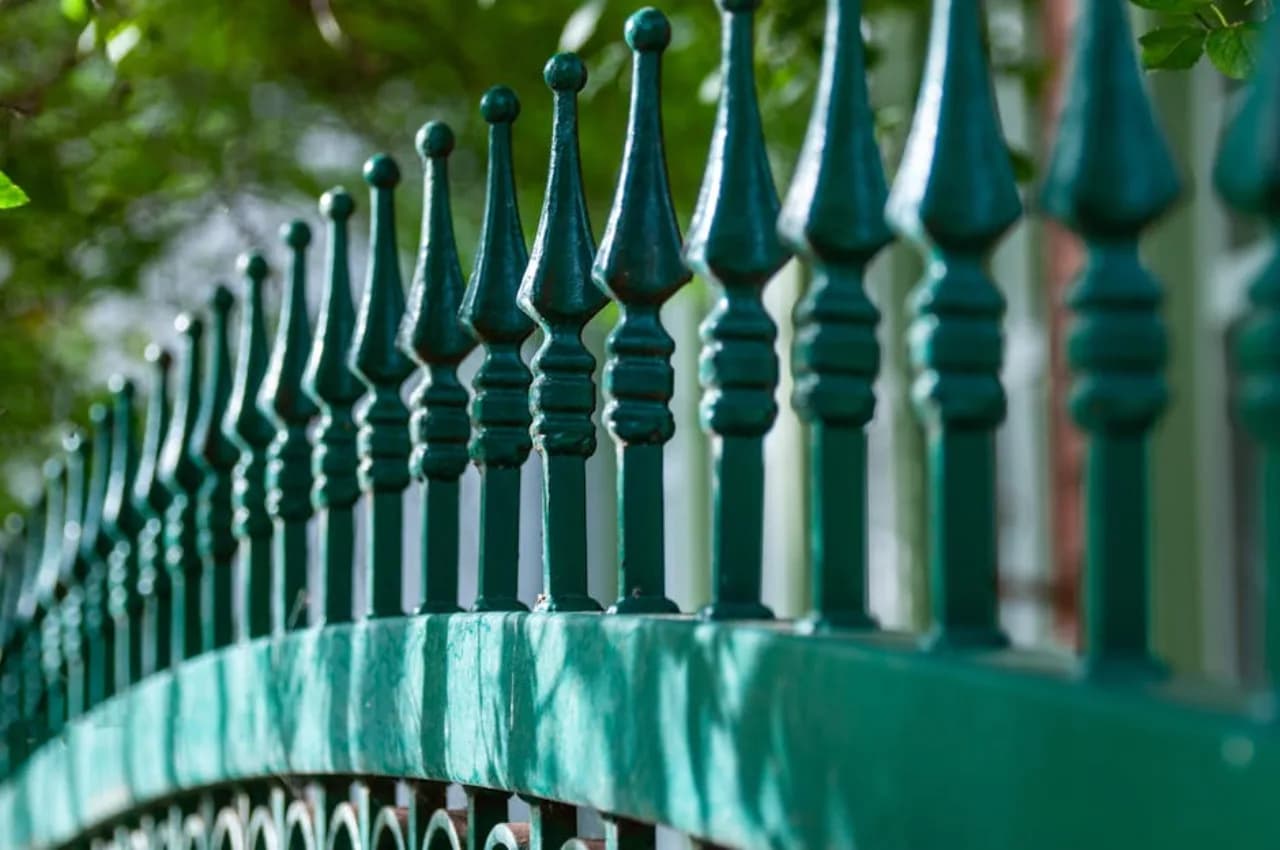
True wrought-iron and steel-tube ornamental. Custom scrollwork, finials, double-arch gates. Powder-coat or hot-dip galvanized + paint. Heritage and modern.
Wrought-iron is the heritage fence — the architectural statement, the curb-appeal multiplier, the material that frames Toronto's Rosedale, Montreal's Westmount, and Vancouver's Shaughnessy. True wrought-iron (hand-forged from low-carbon iron with slag inclusions) is rare in modern fabrication; most "wrought-iron" sold today is steel-tube ornamental with welded ornament and a wrought aesthetic. Fenced.ca supplies all three: true wrought (custom-order, fabricated by Canadian artisan blacksmiths on 6–12 week lead time), steel-tube ornamental (in-stock in standard profiles plus 4-week custom), and cast-iron decorative (heritage replica panels for restoration work).
Profiles: spear-top, ball-cap, fleur-de-lis finials, scrollwork inserts, double-arch and curved-arch gates, monogram inserts for estate gates. Custom drawings welcome — submit a CAD or hand sketch and we'll quote with sample shop-drawings before fabrication.
Finish: powder-coat is the standard for inland applications. For coastal (within 50 km of saltwater) or urban de-icing exposure, specify hot-dip galvanized + powder-coat — the galvanized substrate sacrifices itself for any coating breach, dramatically extending service life at coastal sites where steel without galvanizing pits and rusts within 8–12 years.
Real iron vs aluminum: True wrought iron is hand-forged or hot-rolled steel, weighing 3× more than aluminum, with decade-scale rust risk unless properly maintained. Best for estate gates, heritage restorations, and security applications where mass and presence matter. Canadian fabricators include Amazing Gates (Calgary), Iron Eagle (Ontario), and Forges du Saint-Maurice (Quebec).
Maintenance cycle: Annual visual inspection for rust spots. Touch up with rust-converter primer + oil enamel every 3–5 years. Full sandblast and repaint every 15–20 years (~$15–30 per linear foot). Galvanized core stock cuts maintenance by half.
Custom fabrication: Wrought iron is often drawing-to-spec for residential gates. Standard residential designs include spear-and-scroll, knuckle-and-quatrefoil, and basket-twist. Commercial palisade in steel uses W-section vertical pales with shear-resistant horizontal rails — ASTM F2781 PL2 rated.
Pricing & lead time: Wrought iron pricing: standard 1.5 m spear-top runs $80–140 LF installed, custom designs at $150–280 LF, estate gates (1 leaf 3 m wide) at $3,500–8,000 each. 6–8 week lead time for custom Canadian-fabricated work. Quote includes shop drawings, hot-dip galvanizing, and powder coat in your colour. Lifetime structural warranty when properly maintained.
How wrought-iron fence stacks up against the alternatives — at a residential height of six feet, in median Canadian markets.
Stake the line, check setback rules with the municipality, locate utilities (Info-Excavation in QC, Ontario One Call elsewhere).
End, corner, and gate posts. Concrete footings to frost depth — 1.2m in most of the country, 1.8m in northern Alberta and the territories.
Spaced 10' on centre. Plumb each one before the concrete sets.
1⅝” galvanized pipe, slipped through line-post loop caps.
Tension along the top rail with a come-along, hog-ring to the rail every 24”. Tie wire every line post.
Bottom tension wire, gate hinges, latch hardware. Cap exposed wire ends.
Salt-air corrosion: spec galvanized-after-weave or vinyl coat. Frost line 1.2m.
Permis obligatoire in most municipalities. Bilingual quote PDFs standard.
OBC §9.10 for pool perimeters. Conservation Authority rules along the moraine.
Frost line 1.4–1.5m. Wind-rated panels for the shelterbelt swap-outs.
Coastal: vinyl coat. North: 1.8m frost, schedule-40 pipe for snow load.
Wrought-iron fence cost in Canada in 2026 averages $50-120 per linear foot supply and $80-180 per linear foot installed turnkey. By tier: residential ornamental tubular steel (often sold as "wrought-iron-style") $35-65/ft supply, true forged wrought-iron / custom architectural $80-180/ft supply, heavy commercial palisade with forged elements $100-220/ft. "Wrought-iron" in modern usage typically means powder-coated tubular steel formed in the wrought-iron silhouette — true hand-forged wrought iron is largely a heritage and high-end residential category at $150-400/ft. A 100-foot residential decorative run with one walk gate at the average runs $10,000-18,000 turnkey. Cost variables: panel height (4-ft, 5-ft, 6-ft, 8-ft), spear-top and finial detail, custom pattern work, post-and-base detail (surface-mount vs. core-drill vs. set-in-concrete), and powder-coat colour / finish quality.
DIY-installing a wrought-iron / tubular-steel fence is realistic for an experienced DIYer with two helpers, but harder than vinyl or chain-link. Critical points: panels are heavy (50-120 lbs each for a 6-ft × 6-ft panel), posts must be precisely plumb because tubular-steel panels have rigid pre-set bracket spacing (off by 1 inch and the panel won't bolt up), post depth must be below frost line with concrete bell footing (1.2-2.4 m by city), and gate posts need an oversized footing or core-drilled steel sleeve to take the operating load. Time: 100 ft of decorative panel runs 2-3 weekends for two people. Tools beyond standard: rotary hammer or auger for posts, panel jack or scaffold to hold panels during install, levels and string-line, anti-corrosion touch-up paint. What's not DIY: anything automated (operator install requires CSA-certified electrical), heritage forged work, and any commercial install with structural engineering requirements.
Wrought-iron costs 50-150% more than wood at install but is roughly comparable or cheaper over 30 years because wood requires periodic re-stain, board replacement, and full rebuild around year 20-25 while iron lasts 30-50+ years with only touch-up paint. Comparison at 100 ft over 30 years: cedar board fence at $40/ft installed = $4,000 build + $1,500 in stain cycles (4-6 times) + $1,800 mid-life board replacement + $4,000 rebuild at year 25 = ~$11,300 total, less salvage value. Tubular-steel "wrought-iron-style" fence at $80/ft installed = $8,000 build + $200-500 in touch-up paint over 30 years + maybe a gate hinge service = ~$8,500-9,000 total. True hand-forged wrought-iron is more expensive on every horizon and is bought for the heritage / aesthetic, not the budget math. Wrought-iron also wins on resale value — it reads as a permanent house upgrade where a wood fence reads as maintenance.
Disadvantages of wrought-iron / tubular-steel fence: 1) No privacy — open picket pattern means clear sightlines through; not a privacy fence. 2) Higher upfront cost than vinyl, wood, or chain-link — $50-120/ft supply vs. $25-50 for the others. 3) Heavier panels — install is harder DIY, freight costs more. 4) Rust risk if powder-coat fails — scratches and chips need touch-up paint or the steel oxidizes underneath; coastal and road-salt environments accelerate this. 5) Replacement panel cost — if a panel is damaged by a vehicle or tree fall, replacement is $300-1,500 per panel installed, much higher than a wood section. 6) Sound transmission — open metal doesn't block sound, unlike solid privacy fence. 7) Pattern lock-in — once you commit to a specific picket spacing and finial style, matching repairs in 15 years requires specifying the original manufacturer's profile. Wrought-iron wins on durability and aesthetics, loses on privacy and cost.
True hand-forged wrought iron — the material historically used for fences, gates, railings, and ornamental work through the 19th century — is rarely used today because: 1) Production economics — wrought iron is a labour-intensive metallurgical process (iron heated in a forge, hammered to expel slag, formed at the anvil) that doesn't scale; mild steel and tubular steel are factory-produced at a fraction of the cost. 2) The original Old World wrought-iron suppliers shut down in the early 20th century; most modern "wrought iron" sold today is welded mild steel formed in the wrought-iron silhouette. 3) Powder-coat finishes on tubular steel give similar long-term durability to wrought iron without the cost. 4) Wrought iron is technically softer than mild steel — its corrosion resistance is good but its tensile strength is lower. True hand-forged wrought iron survives in heritage restoration, sculptural work, and high-end residential where the look and material authenticity are the point.
Yes — true hand-forged wrought iron is still available in Canada, but as a specialty product. Heritage-trade blacksmiths and architectural metalworkers produce hand-forged wrought-iron fence panels, gates, and railings on commission for restoration projects, high-end custom homes, and sculpture. Typical sources: independent blacksmiths in Quebec (clustered around Old Quebec and Eastern Townships), heritage restoration shops in Ontario (Toronto, Kingston, Niagara), and a small number of architectural ironworks across the country. Pricing is project-based and runs $150-400+ per linear foot installed for hand-forged work versus $50-120 for tubular-steel "wrought-iron-style." Lead times are 8-20 weeks. For most residential and commercial projects, the practical answer is tubular steel powder-coated to match a wrought-iron pattern — virtually all of what's sold under the name "wrought iron" in Canadian fence retail today is in fact welded mild-steel tubular.
Ready to spec it?