Atlantic
Salt-air corrosion: spec galvanized-after-weave or vinyl coat. Frost line 1.2m.
Fences · agricultural
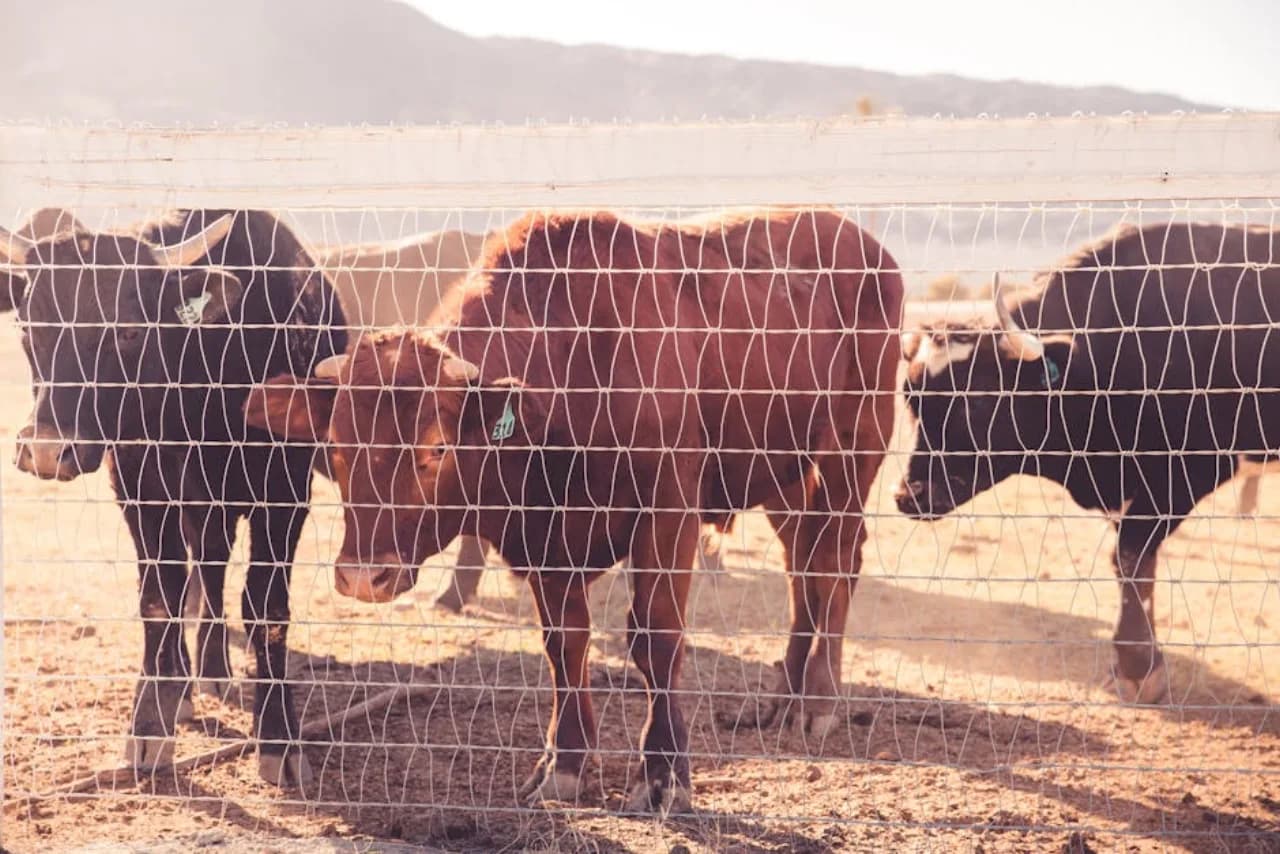
Woven wire (page wire), barbed wire, cattle panels, sheep & goat fence, horse-rail vinyl, high-tensile smooth wire, T-posts. Bulk rolls + pallet pricing.
Farm fence is the bulk-pallet category. Where residential customers buy by the panel and commercial buyers buy by the linear-foot install, farms buy by the pallet — full rolls of wire, bundles of T-posts, palletized energizers and insulators. Fenced.ca operates a dedicated agricultural-supply desk with these substrates: woven wire (page wire) in standard heights 32″ to 60″ and stay-spacings for cattle, sheep, goat, deer, and predator-exclusion configurations; barbed wire in 2-point and 4-point patterns, galvanized Class 3; cattle panels (welded-mesh 16′ rigid panels for portable corrals and lot perimeters); high-tensile smooth wire (12.5-gauge Class 3, the modern energized-fence standard); horse-rail vinyl (white or black PVC top rails over wood post structure, the paddock standard); and T-posts in 5′ to 8′ length, painted or galvanized.
Class 3 zinc is the agricultural durability spec — 0.80 oz/ft² minimum, roughly 3× the coating weight of residential Class 1, suited to ground contact, livestock rub, and 20+ year service life in pasture conditions. Always confirm Class 3 with the mill-test certificate; agricultural sites with Class 1 wire are rusting out within 5 years.
Volume: typical orders run 5–40 pallets per ranch or section. Trucking is full-load or LTL depending on volume and routing; full-load shipments save 30–50% on freight vs LTL.
Wire types: Page wire (woven mesh, 1.2 m, sheep/goats/dogs). Barbed wire (cattle perimeter, 3–5 strand). High-tensile smooth wire (horses, electric-compatible). Field fence (livestock-grade page wire with graduated mesh — smaller at bottom for piglets/lambs, larger at top for cost).
Posts: Cedar posts last 20–25 years in pasture. PT pine 25–30 years. Steel T-posts 40+ years, painted or galvanized. Concrete corner posts for high-tension runs over 200 m. Standard spacing: 3–4 m for field fence, 5–6 m for cattle barbed.
Electric integration: Solar-powered chargers (0.5–1.0 joule output) for short runs, AC-powered (5–15 joule) for big herds. Insulators on every post, galvanized hot-wire at chest height for cattle (1.0 m) or top of withers for horses (1.4 m).
Pricing & lead time: Farm fence installed pricing: 3-strand barbed wire at $3–6 LF, page wire 1.2 m field fence at $6–10 LF, 5-strand high-tensile electric at $5–9 LF, board fence horse pasture at $25–45 LF. Volume discounts at 500 m+ runs. Same-week delivery to most Canadian agricultural zones from dispatch network.
How farm & agricultural fence stacks up against the alternatives — at a residential height of six feet, in median Canadian markets.
Stake the line, check setback rules with the municipality, locate utilities (Info-Excavation in QC, Ontario One Call elsewhere).
End, corner, and gate posts. Concrete footings to frost depth — 1.2m in most of the country, 1.8m in northern Alberta and the territories.
Spaced 10' on centre. Plumb each one before the concrete sets.
1⅝” galvanized pipe, slipped through line-post loop caps.
Tension along the top rail with a come-along, hog-ring to the rail every 24”. Tie wire every line post.
Bottom tension wire, gate hinges, latch hardware. Cap exposed wire ends.
Salt-air corrosion: spec galvanized-after-weave or vinyl coat. Frost line 1.2m.
Permis obligatoire in most municipalities. Bilingual quote PDFs standard.
OBC §9.10 for pool perimeters. Conservation Authority rules along the moraine.
Frost line 1.4–1.5m. Wind-rated panels for the shelterbelt swap-outs.
Coastal: vinyl coat. North: 1.8m frost, schedule-40 pipe for snow load.
For farm fence, "buy" almost always wins — farm fencing is sold as rolls of high-tensile wire, woven wire, or page wire that you install on field-cut wood posts or driven steel T-posts. There's no meaningful prefab vs custom-build choice. The real cost decision is wire type: 4-strand barbed wire is the cheapest at $0.80-1.50/ft supply, high-tensile smooth wire (3-5 strands) runs $1.20-2.80/ft, woven page wire (typically 8-12-32 or 10-47-12 patterns) runs $1.80-4.00/ft, and welded-wire panels run $3.50-6.00/ft. Posts are the second cost: wood ranch posts $8-18 each, driven steel T-posts $8-12, pressure-treated 4x4 corner posts $20-40. For 100 acres of perimeter (roughly 5,300 ft) plan $12,000-25,000 supply for a 4-strand barbed system, $20,000-50,000 for woven wire suitable for cattle and goats.
The best farm fence depends on what you're containing. Cattle: 4-strand high-tensile smooth wire with one electrified strand, or woven page wire for tight rotational grazing. Sheep and goats: woven page wire with a smaller mesh size (4-inch maximum), often topped with one electric strand to stop climbing. Horses: 3-board oak or vinyl-coated polymer rail at 4-5 ft, visible to prevent run-through; never barbed wire (injury risk). Hog: woven hog panel or hot wire at snout and shoulder height. Cross-fencing for rotational paddocks: single-strand electric on insulated step-in posts, cheap and fast to move. Perimeter is permanent (woven or high-tensile), interior is portable (electric tape or polywire). Corner construction is the make-or-break detail — a properly braced H-corner holds wire tension for 25-40 years; a single post fails at year 5.
The cheapest farm fence by a wide margin is single-strand electric on step-in posts — under $0.50 per linear foot supply, ideal for temporary paddocks and rotational grazing on cattle. For permanent perimeter, 4-strand barbed wire on driven steel T-posts is the budget standard at $0.80-1.50 per foot supply, suits cattle in fenced ranchland with low predator pressure. Avoid barbed for horses (injury), avoid it for any property bordering recreational trails (liability), and check your municipal bylaw — some counties restrict barbed wire near roads or trails. The next tier up is high-tensile smooth wire 4-5 strand at $1.20-2.80 supply, which lasts longer and is safer around horses. Cheapest is rarely cheapest in 20-year terms: a $1.50/ft barbed perimeter that rusts and sags at year 10 needs full replacement, while a $2.50/ft high-tensile run will hold 25-40 years.
Yes — Fenced.ca operates as a Canada-wide multi-category fence supplier, with our Canada-wide network in Toronto, Montreal, Calgary, and Vancouver. We ship every fence category we carry — chain-link, wood, vinyl, aluminum, wrought-iron, steel, privacy, picket, split-rail, glass pool, temporary, security, farm, dog, electric, garden, gabion, snow, silt, and driveway gates — to all 10 provinces. The three Territories are quote-on-request because freight is the dominant cost line; we will quote Whitehorse, Yellowknife, and Iqaluit, but a flatbed lane has to be confirmed first. We do not ship internationally. Installation is offered nationally through our vetted installer network where coverage exists, and supply-only for everything else.
Supply means we ship materials — panels, posts, hardware, gates — to your jobsite or yard, and you (or your contractor) install. This is our primary business and covers all 20 fence categories nationally. Rental is offered for temporary fence (construction site fence, event fence, crowd-control barrier), silt fence, and snow fence — categories where the fence comes down after a defined project window. Rental includes delivery, pick-up, and weekly billing; minimum rental is typically one week, with multi-month and multi-site rates available. Installation is offered through our regional installer network in major metros (GTA, Montreal, Calgary, Vancouver, Ottawa, Edmonton) and quoted per-project elsewhere. You can mix and match: supply only, rental only, or supply + install as a turnkey package.
Fence pricing in Canada in 2026 ranges from roughly $15 per linear foot for basic chain-link to $120+ per linear foot for high-end aluminum or wrought-iron with custom gates. Mid-range materials — pressure-treated wood, vinyl, standard aluminum — typically run $30 to $70 per linear foot installed. The biggest cost drivers after material are: post depth (a 4-foot frost line vs. an 8-foot Prairie frost line changes the post count and concrete volume), gate count, terrain (slope, rock, root cuts), and labour market — the GTA, Vancouver, and Calgary command higher install rates than smaller centres. Supply-only costs (no labour) typically run 40-60% of the turnkey figure. We provide itemized quotes that separate materials, hardware, freight, gates, and installation so you can see exactly what scales with project size.
Ready to spec it?